An old game idea gets a new life with AI.
By Craig · A Kupelekanatu Games build story
The road leads past fruit stalls, a fuel station and a weathered outpost. Above the rooftops sits a radio dish. The light is fading, the squad is moving, and that relay is the reason you are here.
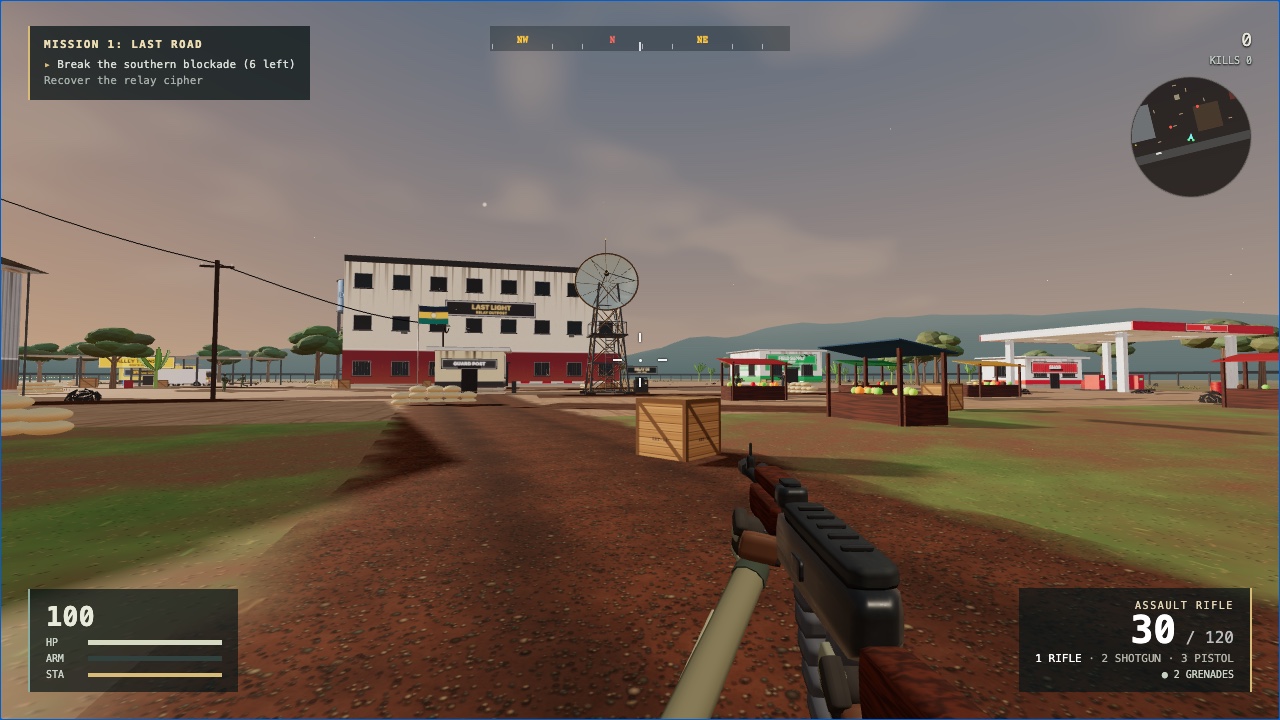
That is the starting point for KABZ V — Last Light, a Kupelekanatu Games experiment bringing together my Hermes, Grok Bot and Muse game tests with an older FPS I started in April.
I wanted to bring the best parts together into a game you could sit down and play: move with the keyboard, aim with the mouse, hear the rifle and the gravel underfoot, understand the objective, make a mistake and try again.
The mission gives those pieces a purpose. Recover the relay cipher. Restore power and defend the uplink. Then deal with the field leader and bring the squad to extraction. The dish gives you a landmark to navigate toward from across the yard.
Parts worth keeping.
The earlier versions supplied a lot to work with. The first had the town layout, squad members, weapons and cover. The next organized the experience into missions with earned upgrades and supplies. The later version added more detailed materials, weapon animation and spatial audio. The April experiment contributed the simple idea of visible travelling rounds: you can react to a shot, and cover has to physically stop it.
Muse and Grok Bot also contributed new work. Muse made concrete and gravel materials for the world. Grok Bot made rifle variations, reload sounds, footsteps, the relay activation cue and a dusk ambience bed. These were actual files from their tasks, selected and integrated into the game. Both contributions used procedural generation; the sound was synthesized and the textures were authored with Python, NumPy and Pillow.
I like the small moments this makes possible: the reload has separate mechanical steps; the ground sounds change as you move; the relay answers when power comes back. They give the code something to feel like.
The finish takes attention.
The comparison footage shows how far the prototypes had already come, and where finishing still mattered. We kept a full minute from each version, including rough edges, deaths and retries. The newest build is presented first on the game page, followed by the earlier versions so you can see the starting points.
One of the biggest visual improvements came from removing a faulty post-processing path. Another came from correcting the direction of the road's triangles. More effects were not automatically making a better game. The useful loop was to play it, look closely, identify the problem and test the change.
An automated playthrough completed all three chapters using real keyboard and mouse events, with read-only telemetry guiding the inputs. The route included the full uplink defense, earned equipment upgrades, the field leader and extraction. The team also checked death and retry, released triggers, pause and resume, and returning after the window loses focus.
That is what excites me about what AI can do today. Getting an idea into a playable 3D space is much more accessible. It becomes possible to explore a world, hear it and test its rules while the idea is still fresh.
I would happily call the start easier. I would still reserve time for the finish. Direction, taste and testing are what turn a collection of generated parts into something worth playing.
Play, watch, and choose the next update ↗
How to read the comparison.
This is a development case study, not a controlled model benchmark. The originals overlap in lineage and were not created from identical documented prompts. The Hermes/Grok Bot/Muse trio is my original test framing. Historical write receipts support Hermes lineage for v2; the surviving records do not establish the exact v3/v4 author mapping, so those clips use version labels. Earlier creation time and human labor were not measured.
The clips use automated keyboard/mouse events guided by read-only telemetry and were captured at 1280 × 720 / 30 fps. Original HTML was preserved. v2 needed a compatibility loader supplying the official Three.js CapsuleGeometry constructor missing from its requested engine version. The three public prototype clips and their comparison edit are silent; inherited audio was removed. The KABZ V showcase retains its actual effects and ambience with music muted. The public playable edition excludes inherited soundtrack files. Full credits.